Local SEO success relies on understanding what your competitors are doing right. Competitor analysis helps you identify the strategies driving their rankings and uncover areas where you can improve. Here’s what you need to know:
- Why It Matters: Businesses that analyze competitors outperform others by 40% in local rankings. Nearly 50% of Google searches are location-based, and 80% of local searches convert into customers.
- Steps to Identify Competitors: Use local search terms like “plumber near me” or “dentist in [city]” to find competitors in Google’s Local 3-Pack. Tools like BrightLocal or Local Falcon can simulate searches from different locations.
- Key Tools: Platforms like Semrush, Ahrefs, and Moz Local can help analyze keywords, backlinks, and citation gaps.
- What to Analyze: Study competitor keywords, backlinks, Google Business Profiles, and on-page SEO. Look for citation consistency, review strategies, and technical SEO elements like site speed and mobile performance.
- Actionable Steps: Fill keyword gaps by creating service-area pages, build high-value local backlinks, and optimize your Google Business Profile with photos, Q&A, and structured data.
Start by running a keyword gap analysis or auditing competitor backlinks. Regularly updating your strategy based on competitor insights can lead to more leads, better rankings, and stronger local visibility.
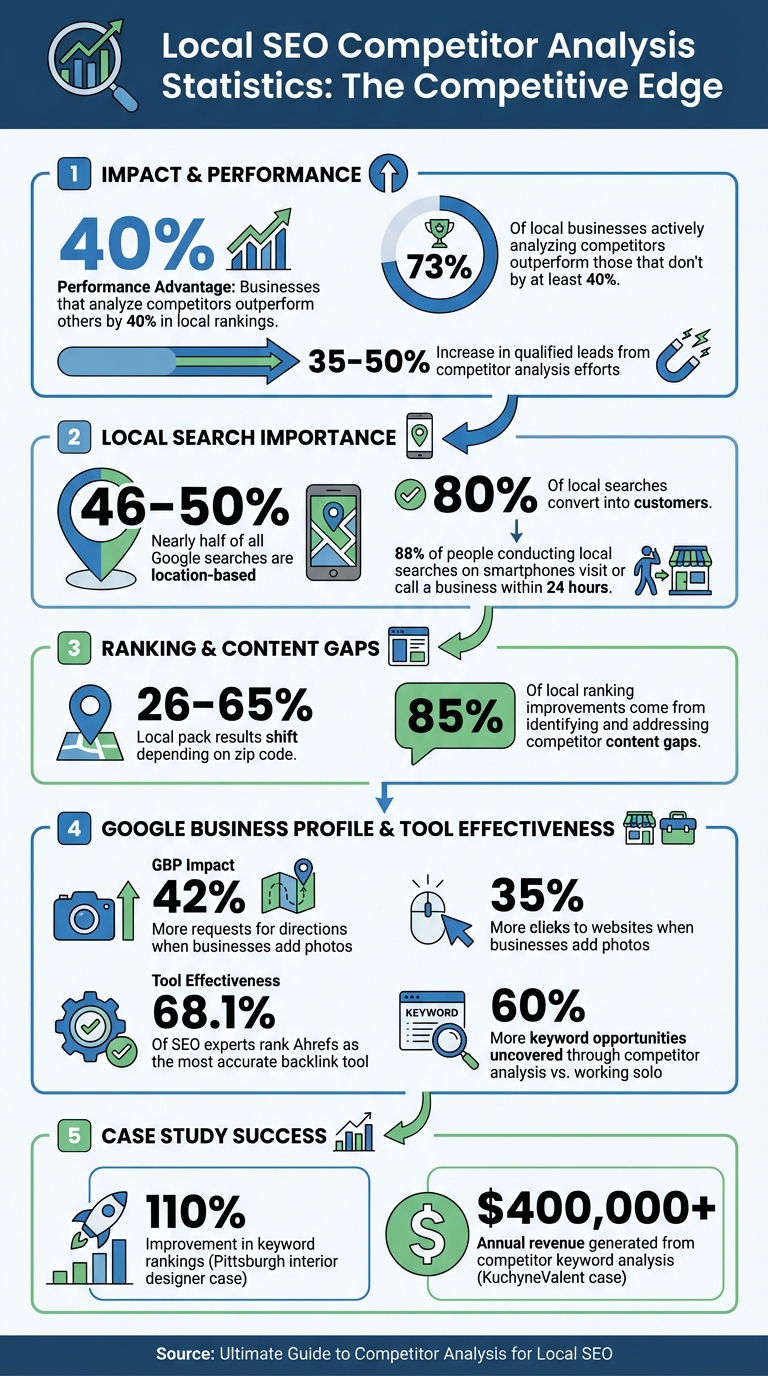
Local SEO Competitor Analysis: Key Statistics and ROI Impact
Finding and Researching Local Competitors
How to Find Your Local Competitors
Your competitors aren’t just the businesses down the street – they’re anyone who pops up when potential customers search for the services you offer. Miriam Ellis, a Local SEO Subject Matter Expert at Moz, highlights this perfectly:
“There is no #1 for all searchers. A user on the north side of town may see a completely different local pack of results if they go south”.
In fact, local pack results can shift by 26%–65% depending on the zip code. This means you’ll need to explore search results from multiple locations to pinpoint your real competitors.
Start by conducting targeted “near me” searches using 5–10 core keywords like “[service] near me” or “[service] in [city].” Look for businesses that consistently appear in the Local 3-Pack. Then, expand your search by simulating different service area locations. You can do this by physically moving to new areas or using browser tools like GS Location Changer or BrightLocal’s Local Search Results Checker.
But don’t stop at Google. Check Instagram for local hashtags and browse Facebook groups to spot competitors who might have strong social engagement but lower visibility in traditional search. When building your competitor list, skip directories like Yelp and TripAdvisor – they’re platforms for boosting visibility, not direct competitors.
Once you’ve identified your competitors, dive deeper into their strategies with specialized tools.
Using Tools to Research Competitors
After manually compiling your competitor list, advanced tools can help you take your research to the next level. These tools reveal patterns and insights that might otherwise go unnoticed. For example, platforms like Local Falcon and BrightLocal use geo-grids to map out where competitors outperform you on a block-by-block basis. This bird’s-eye perspective can help you identify areas where your business might be falling short.
For a closer look at keyword opportunities, tools like Semrush and Ahrefs are game-changers. Back in 2017, the local manufacturer KuchyneValent used Semrush to analyze competitor keywords and traffic. This strategy helped them generate over $400,000 in annual revenue by addressing untapped market gaps. Similarly, an interior designer in Pittsburgh utilized keyword gap analysis to boost rankings by 110% and increase Google Business Profile interactions by 89% in just 90 days.
Here’s a quick comparison of tools to consider:
| Tool | Starting Price | Best For |
|---|---|---|
| Moz Local | $14/month | Listing management |
| Semrush Local | $20/month | Map Rank Tracker and heatmaps |
| BrightLocal | $39/month | Citation building and local audits |
| SE Ranking | $62/month | Keyword position tracking |
| Local Falcon | Credit-based | Hyper-local geo-grid rank tracking |
For quick insights into competitor Google Business Profiles, try the GMB Spy Chrome extension. It lets you view their primary and secondary categories directly on their listings. Additionally, tools like Whitespark and BrightLocal can help you identify citation gaps by showing which directories list your competitors but not your business.
When it comes to backlink analysis, Ahrefs is a favorite among SEO experts – 68.1% of them rank it as the most accurate tool for backlink data. This makes it an excellent resource for analyzing competitor link profiles and discovering local PR opportunities.
Analyzing Competitor SEO Strategies and Metrics
Keyword Research and Gap Analysis
To understand what drives traffic to your competitors, start by identifying the keywords they rank for. A good way to do this is through manual SERP research using terms like “[service] near me,” “[service] in [city],” or “best [service] [location].” This helps you spot the competitors that frequently appear in search results. Next, conduct a keyword gap analysis by comparing your domain with up to three competitors. This process uncovers two key insights: “new keyword opportunities” (terms they rank for but you don’t) and “keywords to improve” (terms where you rank in the top 20 but are being outranked).
Sorting by Traffic Lift – a metric that estimates how much traffic you could gain by overtaking a competitor – can help prioritize your efforts. Focus on high-commercial intent keywords with geographic modifiers, like “emergency plumbing in Dallas,” instead of broader industry terms. This approach can uncover up to 60% more keyword opportunities compared to working solo.
| Metric | Description | Strategic Use |
|---|---|---|
| Traffic Lift | Estimated traffic gain by surpassing a competitor. | Focus on high-impact content updates. |
| Keyword Difficulty | Measures how hard it is to outrank competitors. | Spot “low-hanging fruit” for quick wins. |
| Overlap | Shared keywords between you and competitors. | Benchmark your performance against direct rivals. |
| Opportunity Score | Combines volume and low competition into one metric. | Choose new keywords for service page improvements. |
Once you’ve analyzed keywords, shift your attention to backlinks to gauge competitor authority.
Backlink Analysis and Domain Authority
Backlinks are a strong indicator of how much trust and authority Google assigns to a website. Metrics like Domain Authority (DA) and Page Authority (PA) can predict ranking potential. However, instead of focusing solely on the total number of backlinks, prioritize the number of unique referring domains. Multiple links from the same source provide diminishing returns.
For local SEO, the quality of backlinks matters more than quantity. Links from locally relevant sources – such as government (.gov) and institutional (.edu) websites, local news outlets, and community sponsorships – carry significant weight. As Zac Galioto, Founder of RedShift Local, explains:
“A single backlink from a respected local news site can carry more weight than dozens of low-quality citations.”
Tools like Ahrefs’ Authority Gap Analysis can help identify high-DA local news sites or organizations that link to multiple competitors, revealing untapped PR opportunities. You can also filter backlink reports by anchor text containing local keywords to find geo-specific links. Searching for a competitor’s NAP (Name, Address, Phone number) in Google can uncover citations and third-party mentions that Google considers authoritative.
| Link Source Category | Examples | Local SEO Value |
|---|---|---|
| Institutional | City/county government sites, universities, libraries | Very High |
| Business Authority | Chamber of Commerce, industry groups, BBB | High |
| Local Media | Neighborhood newspapers, radio/TV sites, blogs | High |
| Community/Event | Charity sponsorships, sports leagues, festival sites | Medium-High |
| General Directories | Yelp, Yellow Pages, Apple Maps | Medium (Foundational) |
With backlinks analyzed, the next step is to focus on competitors’ on-page and technical SEO strategies.
On-Page and Technical SEO Factors
Using insights from keywords and backlinks, evaluate competitor on-page signals and technical performance. Start by analyzing their title tags, meta descriptions, and H1–H3 headings for target keywords, city names, and state abbreviations. Look for hyper-local content, such as neighborhood-specific pages, mentions of local landmarks, or service descriptions tailored to the community.
Check whether their NAP (Name, Address, Phone number) is consistent across their website and Google Business Profile. This consistency is a strong trust signal for search engines. Also, see if they use structured data – like LocalBusiness, Review, FAQ, or Service schema markup – to enhance local relevance.
On the technical side, compare your site’s Core Web Vitals (Largest Contentful Paint, First Input Delay, Cumulative Layout Shift) to competitors using tools like Google PageSpeed Insights. Mobile performance is especially critical, as 88% of people conducting local searches on smartphones either visit or call a business within 24 hours. Additionally, check if competitors embed Google Maps on their contact or location pages to reinforce their geographic relevance.
Lastly, assess their conversion elements. Features like online chat, instant appointment scheduling, or prominent click-to-call buttons can make a big difference in user engagement. As Casey Meraz, Founder of Juris Digital, highlights:
“If your users visit your site and then click back to the search results it indicates that they didn’t find what they were looking for… making information prevalent [above the fold] is essential.”
Keep in mind that 85% of local ranking improvements come from identifying and addressing competitor content gaps.
Turning Competitor Data into Action
Optimizing Your SEO Strategy Based on Competitor Data
Take the insights from your keyword, backlink, and technical analysis and turn them into a clear, actionable plan. Start by building an Opportunity Scoring Matrix to prioritize your efforts. For example, high-volume, low-competition keywords uncovered during competitor research should be marked as Priority 1 – these are your quickest wins. Medium-volume, low-competition keywords can be Priority 2, while high-volume, medium-competition terms should fall into Priority 3 for long-term growth. Keywords with strong commercial or local intent, like “emergency water heater repair in Dallas“, deserve dedicated landing pages with clear calls-to-action.
If your competitor analysis shows they’re outranking you due to higher domain authority, focus on building high-value local backlinks. Aim for links from city government (.gov) websites, chambers of commerce, or educational institutions (.edu), as these carry significant weight in local search. Combine backlink lists from your top 3–5 competitors into one spreadsheet, sort them by authority, and prioritize outreach to the most valuable sources.
On the technical side, make sure your site includes local keywords in title tags and H1 headings, especially if competitors are successfully using city and state modifiers. Add LocalBusiness schema markup if your top competitors are already utilizing it, as this helps search engines better understand your local relevance. Keep an eye on competitor listings for “website justifications” – snippets of text Google pulls into the Local Pack – and incorporate similar keyword phrasing into your own content. These adjustments will strengthen your on-page and technical SEO efforts.
Once your technical foundation is solid, shift your focus to addressing content gaps for local search opportunities.
Creating Content to Fill Keyword Gaps
Addressing content gaps is where most local ranking improvements happen – research shows it accounts for 85% of gains. When you find keywords that competitors rank for but you don’t, create dedicated service-area pages instead of lumping them into generic service descriptions. For instance, if a competitor ranks for “emergency plumbing in Downtown Austin” and you only have a general plumbing page, build a new landing page specifically targeting that neighborhood and service combination.
Use the structure of top-ranking competitor pages as a guide. Pay attention to their headings, URL formats, and how they organize information – this provides clues about what Google finds relevant. Include local trust elements like testimonials from nearby customers, mentions of local landmarks, or references to community events. Make sure to address the user’s primary intent “above the fold” to reduce bounce rates, as users who leave quickly can hurt your rankings.
Here’s a real-world example: an interior designer in Pittsburgh saw a 110% improvement in keyword rankings after creating content to fill gaps identified through competitor research. This example highlights how strategic content creation can deliver measurable results.
After optimizing your site, don’t overlook the impact of improving your Google Business Profile.
Improving Local Search Visibility
Your Google Business Profile is a critical piece of your local SEO strategy. A food manufacturer representative boosted interactions on their profile by 89% in just 90 days after making targeted updates based on competitor audits. Review what top competitors include in their profiles – like photos, posts, and Q&A sections – and aim to match or exceed their efforts. Businesses that add photos to their profiles, for instance, see 42% more requests for directions and 35% more clicks to their websites compared to those that don’t.
Focus on securing “dofollow” local citations to increase your authority. Use competitor backlink reports to identify links from neighborhood blogs or regional news sites by filtering for local keywords or anchor text. Additionally, monitor competitor brand names and NAP (Name, Address, Phone) mentions monthly to uncover new local PR or sponsorship opportunities as they arise.
These steps are the final piece of a complete competitor analysis strategy. Research shows that 73% of local businesses that actively analyze competitors outperform others by 40% or more in local rankings, and such efforts typically lead to a 35–50% increase in qualified leads. The key is consistency – turn your data into targeted content, outreach, and profile updates that directly address the gaps you’ve identified.
sbb-itb-3e387e1
How To Do A Competitive Analysis For Local SEO – Expert Tutorial
Conclusion
Competitor analysis isn’t something you do once and forget – it’s an ongoing effort that sets thriving businesses apart in local search. The numbers back this up: 73% of local businesses that actively analyze their competitors outperform those that don’t by at least 40% in local rankings. With nearly half (46%) of all Google searches tied to location and 80% of local searches leading to conversions, keeping an eye on your competitors’ strategies can directly translate into more customers for your business.
The long-term payoff of a thorough competitor review is undeniable. As Casey Meraz, Founder of Juris Digital, puts it:
“Examine the competition, craft a plan, and win long term.” – Casey Meraz
To stay ahead, focus on three key areas: Google Business Profile optimization, on-page and technical SEO, and off-site authority building. Start by identifying keyword gaps where your competitors are ranking higher. Then, create hyper-local content to fill those gaps and secure the same high-quality backlinks that are boosting your competitors’ visibility. Consistently applying these tactics can turn competitor insights into real-world results.
Set aside 4–6 hours each month to review rankings, update your Google Business Profile, and seek out new backlink opportunities. Markets change, Google’s algorithm evolves, and your competitors are always looking for an edge. Regular analysis ensures you stay ahead instead of scrambling to catch up. Whether you’re a hair salon, a law firm, or a plumbing business, those dominating local search didn’t get there by chance – they used data-driven strategies rooted in competitor intelligence.
Don’t wait. Start now. Run a keyword gap analysis, audit your citations, or update your Google Business Profile based on what your top competitors are doing. In the end, the businesses that succeed in local search are the ones that consistently act on what they learn.
FAQs
How do I find my local competitors for SEO analysis?
To pinpoint your local competitors for SEO analysis, start by searching the keywords you’re aiming to rank for. For example, try searching phrases like “plumbing services in Austin, TX” on Google and Google Maps. Pay close attention to the businesses that show up in the local pack, organic search results, and related suggestions. These are your real SEO competitors – businesses actively competing for visibility online – not just the ones you know as direct industry rivals.
From there, leverage tools like Google Business Profile audits or local SEO platforms to gather a list of top-performing competitors for your chosen keywords. These tools can reveal valuable insights, such as their citation profiles, backlink strategies, keyword usage, and customer reviews. You can also run a keyword gap analysis to uncover search terms where your competitors are ranking, but you’re not. This step can highlight opportunities you might have missed.
To solidify your research, check industry-specific directories like Yelp or Angie’s List and monitor social media mentions. Businesses that consistently appear across these platforms are likely the key players in your local market. By combining search engine results, SEO tools, and manual research, you’ll gain a thorough understanding of your local competition and be better equipped to fine-tune your SEO approach.
What are the best tools for analyzing your competitors’ local SEO strategies?
To get a clear picture of your competitors’ local SEO strategies, leveraging the right tools can make all the difference:
- Keyword research tools like Semrush, Ahrefs, and Moz can show you the search terms your competitors rank for. This insight helps you discover new opportunities to target keywords that matter to your business.
- Backlink analysis tools such as Ahrefs and Moz let you see where competitors are earning backlinks. You can identify high-authority sites linking to them and spot gaps in your own backlink profile that you can work to close.
- For local SEO insights, platforms like BrightLocal and Moz Local are great for auditing details like your competitors’ Google Business Profile (GBP) listings, citation accuracy, and reviews. These tools help you fine-tune your local online presence.
- Review monitoring tools help you track competitor reviews, ratings, and customer sentiment. This information can guide your own reputation management efforts and highlight areas where you can stand out.
By combining data from these tools, you can fine-tune your local SEO strategy, boost your visibility, and gain a competitive edge in local search rankings.
How can I prioritize SEO improvements using competitor analysis?
To improve your local SEO rankings, start by diving into competitor data that influences local visibility. Pay attention to factors like Google Business Profile (GBP) categories, review volume, citation consistency, target keywords, backlink quality, and site speed. Pinpoint the areas where competitors are outperforming you and focus on bridging those gaps.
Kick things off with easy, high-impact updates. For example, add any missing citations, fine-tune your GBP fields, and ramp up efforts to generate more reviews. These quick adjustments can deliver noticeable results without requiring a ton of time or resources.
Next, explore where your competitors leave opportunities on the table. Keyword and content gaps often emerge during competitor analysis. Use this insight to create locally-focused content targeting topics where your competitors have weak optimization or low rankings.
Finally, tackle long-term strategies like securing high-quality backlinks and resolving technical issues such as mobile usability and site speed. While these efforts take more time, they offer lasting benefits, keeping your business competitive in local search rankings.
Related Blog Posts
- Small Business SEO Guide: First-Page Ranking Basics
- Geo-Targeted Content for Local SEO Rankings
- How to Use Keyword Tools for Local SEO
- Custom SEO Dashboards: Key Metrics To Track