- Why Local SEO Matters: Over 40% of Google searches are local, and 80% of people search locally weekly. Plus, 28% of these searches lead to a purchase within 24 hours.
- The Problem: Many businesses waste time targeting irrelevant keywords or competing with national brands.
- The Solution: Use keyword tools to find what your local audience is searching for and focus on terms with real demand.
Key Steps:
- Choose the Right Tools: Start with free options like Google Keyword Planner and Google Trends for local search data. Advanced tools like Semrush and Ahrefs offer competitor insights and local keyword opportunities.
- Create Local Keywords: Combine your service + modifiers (e.g., "best", "24-hour") + location (e.g., "plumber in San Diego").
- Analyze Metrics: Focus on keywords with low difficulty, clear intent, and local search volume.
- Optimize Your Website: Use keywords naturally in titles, meta descriptions, headers, and content. Optimize your Google Business Profile for local searches.
- Track Results: Regularly monitor rankings, clicks, and local search trends to refine your strategy.
By following these steps, you’ll attract more local customers and improve your visibility in your area. Keep your strategy updated as search habits evolve.
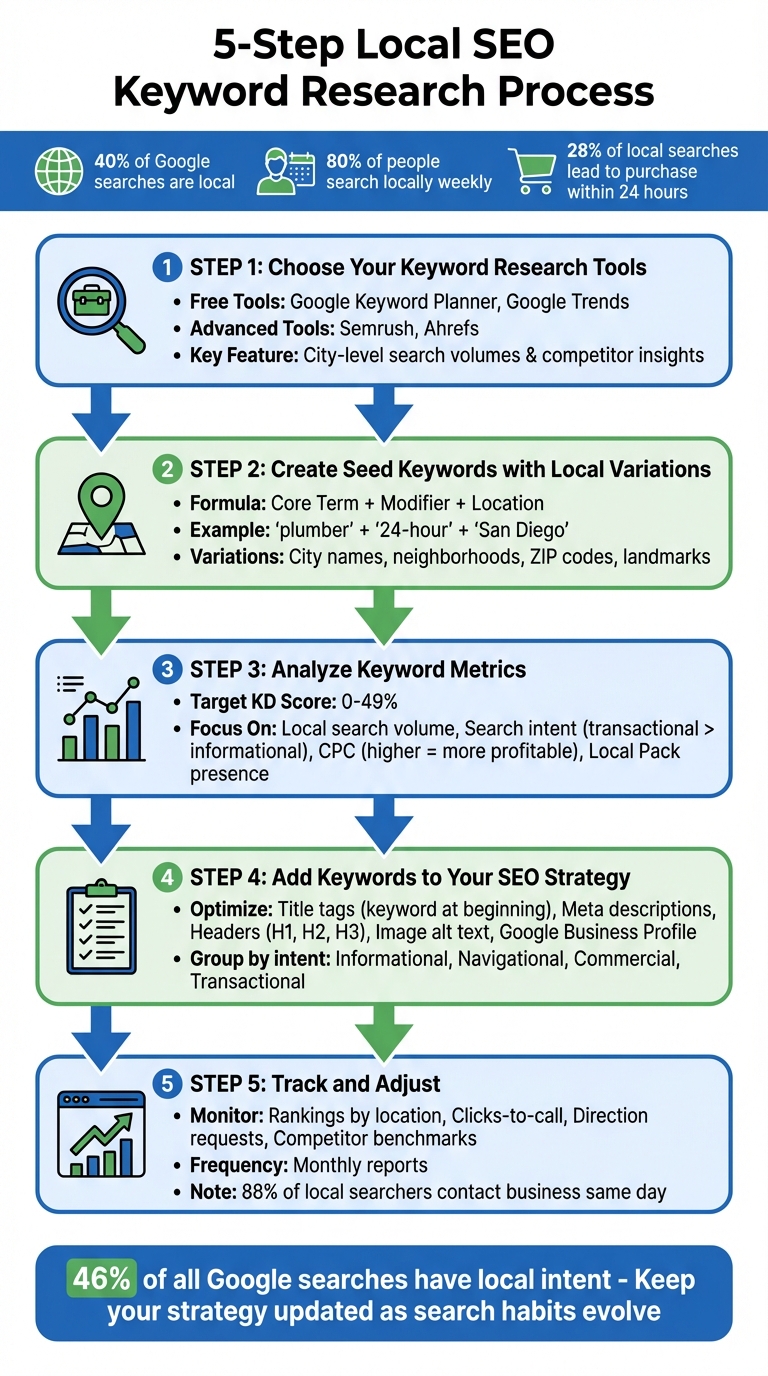
5-Step Local SEO Keyword Research Process
Keyword Research Example for Local SEO (Step by Step)
Step 1: Choose Your Keyword Research Tools
Picking the right tools is crucial for effective local keyword research. You’ll want platforms that give you insights into city-level search volumes, regional trends, and competitor rankings. The good news? There are plenty of free options that can deliver solid data without stretching your budget. Let’s dive into some of the best tools to get started.
Google Keyword Planner is a great place to begin. It’s free to use (you’ll need a Google Ads account) and lets you narrow down search volumes by cities, regions, or ZIP codes, helping you account for local search variations. Plus, it provides "Top of Page Bids", which show how much advertisers are willing to pay for clicks – a handy way to gauge commercial intent. This tool lays the groundwork for identifying the local keywords that are worth your time and effort.
Google Trends is another powerful ally. It helps you track relative interest over time and across locations, revealing seasonal and regional patterns. You can compare up to five keywords to see which cities have the highest search interest. For instance, a tax preparation service might notice a spike in searches during tax season, while a roofing company could see increased interest after severe weather. Google Trends also highlights trending related queries, which can point you toward emerging local topics. In smaller markets where traditional keyword tools may show limited data, Google Trends can confirm whether there’s actual interest in your services. This ensures you’re focusing on real demand in your area.
Semrush and Ahrefs take things to the next level by offering detailed competitor research. Their expansive keyword databases and metrics, like keyword difficulty scores, help you decide which terms to prioritize. Semrush’s Keyword Magic Tool even includes a filter for "Local Pack" results – those map-based listings that often appear at the top of local search results. The Keyword Gap tool is another standout feature, allowing you to compare your site with competitors to uncover missed keyword opportunities. For example, in 2023, Kody Smith used these tools to help a pet waste removal business rake in nearly $300,000 in additional revenue. Both platforms offer free versions – Semrush allows 10 searches per day, while Ahrefs provides a free keyword generator – but their paid plans unlock deeper insights to help you outsmart local competitors and target high-value opportunities.
"Local keyword research is your secret weapon. By knowing what potential customers are searching for online, you can make your business more visible to those who matter most – local buyers." – Backlinko
Step 2: Create Seed Keywords with Local Variations
Start by identifying your seed keywords – these are the basic terms that describe your business, like "bakery", "plumber", or "law firm." Once you add location details and service-specific modifiers, these simple terms evolve into highly targeted keywords that match what local customers are searching for. The trick is turning broad industry terms into precise phrases that resonate with local intent.
Begin by listing your primary services or products. For example, a dental office might include services like "teeth whitening", "emergency dentist", or "Invisalign." Then, add modifiers such as "affordable", "24-hour", or "best." Finally, incorporate location details like city names, neighborhoods, ZIP codes, nearby landmarks, or even regional nicknames like "Twin Cities" or "NYC." This simple formula – core term + modifier + location – helps you craft keyword variations that attract high-intent local searchers.
"Keywords are the building blocks of your online presence, each one a combination of three key components: a modifier, a core term, and a location." – Neil Patel, Co-Founder, NP Digital
For instance, a dental practice in Minneapolis’s Warehouse District might target five different geo-modifiers for the same service: "Minneapolis" (official city name), "MPLS" (abbreviation), "Warehouse District" (specific area), "Downtown Minneapolis" (broader neighborhood), and "Twin Cities" (metro region). Similarly, Milano Bakery in Joliet, Illinois, created 391 local keyword variations and ranked at the top for "joliet bakery", pulling in an estimated 3,000 monthly desktop visits.
Don’t forget implicit modifiers like "near me", "nearby", or "open now" to capture urgent local searches. It’s also important to consider how locals actually speak. For instance, in some areas, people might search for "sub shops", while others might use "hoagie shops" or "grinder shops." Use tools like Google Autocomplete to uncover these local language quirks. Just type your seed keyword into the search bar and review the auto-suggestions – these hints reveal what people in your area are actively searching for.
Step 3: Analyze Keyword Metrics for Local Search
Now that you’ve compiled a solid list of local keyword variations (from Step 2), it’s time to dig into their performance metrics. Not all keywords are equally useful – some may have high search volumes but fail to attract the right audience, while others with seemingly low search numbers can still drive consistent, valuable local traffic. Your goal here is to identify and prioritize keywords that align with local relevance and intent.
Start by narrowing your keyword data to your specific city or ZIP code instead of relying on national averages. Many tools default to country-level data, but you’ll want to adjust the filters to focus on your actual service area. This ensures that you’re analyzing search behavior specific to your local audience, not trends across the nation.
When evaluating keywords, aim for Keyword Difficulty (KD) scores between 0-49% – these are typically easier to rank for in local searches. Don’t overlook keywords with low search volume if they match your audience’s intent. For instance, even if a term appears underutilized in tools, its presence in Google Autocomplete confirms real-world usage, especially in smaller towns or niche markets.
Search intent is a key factor to consider. A keyword with just 10 monthly searches but clear transactional intent (e.g., "buy artisan bread Katy") may be far more valuable than one with 1,000 searches and purely informational intent. Additionally, check the cost per click (CPC) – a high CPC often indicates that businesses see this term as profitable and worth targeting. You’ll also want to see if the keyword triggers a Local Pack (the map-based business listings). If it does, optimizing your Google Business Profile becomes essential.
Compare Keywords Using a Metrics Table
To make your analysis more actionable, use a metrics table to compare keywords side by side. This approach helps you focus on the factors that directly impact your local SEO efforts. Here’s a breakdown of what to track:
| Metric | What It Tells You | Why It Matters for Local SEO |
|---|---|---|
| Local Search Volume | Average monthly searches in your city/ZIP | Indicates potential foot traffic and local leads |
| Keyword Difficulty (KD%) | How difficult it is to rank in the top 10 results | Helps identify easier opportunities to rank locally |
| Search Intent | Purpose behind the search (e.g., Informational, Transactional) | Ensures traffic aligns with your business goals and converts |
| CPC (Cost Per Click) | What advertisers pay per click | High CPC suggests terms that are likely to drive conversions |
| Local Pack Presence | Whether the keyword triggers a Map Pack | Shows if optimizing your Google Business Profile is necessary |
Another thing to keep in mind: implicit keywords (like "plumber") often perform better than explicit ones (like "plumber in Katy"). This is because Google uses the searcher’s IP address to deliver local results automatically. By researching both implicit and explicit keywords, you can capture a broader picture of local search demand.
Armed with these insights, you’ll be ready to strategically integrate your chosen keywords into your local SEO plan.
sbb-itb-3e387e1
Step 4: Add Keywords to Your Local SEO Strategy
Now that you’ve done your keyword research, it’s time to put those findings to work and boost your local SEO. The idea is to strategically place your keywords across your website and listings so that Google clearly understands what you offer and where you operate. Think of it as matching the right keyword to the right page and purpose, ensuring your business stands out to the right audience.
Start by organizing your keywords based on what users are trying to accomplish when they search. For instance, someone typing "how to plan a wedding in Boston" is looking for guidance, while "book wedding venue Boston" shows they’re ready to make a decision. These two searches reflect completely different goals, so grouping your keywords by intent is critical.
Group Keywords by Search Intent
Search intent is all about understanding what users want. There are four main categories: informational (seeking knowledge), navigational (looking for a specific place), commercial (exploring options), and transactional (ready to act). Matching your content to these intents ensures you’re addressing users’ needs effectively.
For example, if you own a plumbing business, "how to fix a leaky faucet" is an informational query that would work well for a blog post. On the other hand, "emergency plumber in [City]" is transactional and belongs on a service page with a clear call-to-action and contact info. Assigning keywords to the right content type helps avoid confusion and keeps your site focused.
Here’s a quick breakdown:
| Search Intent Category | User Goal | Example Local Keyword |
|---|---|---|
| Informational | Researching/Learning | "how to plan a wedding in Boston" |
| Navigational | Finding a specific site/place | "Hampshire House Boston" |
| Commercial | Comparing options | "best wedding venues in Boston" |
| Transactional | Ready to purchase or book | "book wedding venue Boston" |
Once you’ve grouped your keywords, map them to specific pages on your website. Assign one primary keyword and a few variations to each page to avoid keyword cannibalization. Using a simple spreadsheet can help you keep track of which keywords are tied to which pages, ensuring each page targets a specific user need.
Use Local Keywords in On-Page Elements
After organizing your keywords, the next step is to weave them naturally into your site’s on-page elements. Google looks at these elements to determine relevance, so it’s important to use keywords seamlessly in areas like title tags, meta descriptions, headers, body content, and URLs.
Start with your title tags. Make sure your primary keyword appears at the beginning. For example, "Emergency Plumbing Services in Katy, TX | 24-Hour Repairs" is clear, keyword-rich, and sets clear expectations for users.
Meta descriptions, while not a direct ranking factor, can significantly impact click-through rates. For transactional pages, use urgency-driven phrases like "Open Now", "Same Day", or "Emergency" to encourage action. A meta description like "Need a plumber in Katy? We offer 24-hour emergency service – call now for same-day repairs" speaks directly to users who need immediate help.
Use headers (H1, H2, H3) to structure your content and reinforce keyword relevance. Your H1 should include the primary keyword, while H2 and H3 tags can focus on secondary or long-tail variations. For instance, an H2 like "Affordable Furnace Repair in East Tucson" naturally combines location and service without sounding forced.
Don’t overlook image optimization. Rename image files with local keywords before uploading them – think "bakery-miami-beach.jpg" instead of something generic. Also, use descriptive alt text that includes your location, boosting your visibility in image searches and reinforcing local relevance.
If your business operates in multiple locations, create unique landing pages for each one. These pages should feature specific NAP (Name, Address, Phone) details and localized content. Avoid duplicating content across these pages, as this can lead to penalties for using "doorway pages."
Lastly, fine-tune your Google Business Profile by incorporating keywords into your business description, service titles, and even review responses. For example, when replying to a review, you might say: "Thanks for trusting us with your furnace repair in East Tucson!" This not only engages your customers but also strengthens your local SEO presence.
"Local keyword research is the foundation of any successful local SEO strategy. Get it wrong, and your dream customers will end up knocking on your competitor’s door." – Kyle Roof, Co-Founder, POP
Step 5: Track and Adjust with Katy SEO Solutions
After integrating your keywords, the next step is keeping an eye on how well your local SEO strategy is performing. Search results can shift frequently, so ongoing tracking is essential. Katy SEO Solutions uses geo-grid rank tracking, a tool that simulates searches from specific local areas. This delivers a visual map of your business’s visibility, making it easier to see where you stand. Considering that 88% of local searchers contact a business on the same day, monthly reports are a must. These reports break down ranking trends, competitor benchmarks, and conversion metrics like clicks-to-call and direction requests, giving you a clear picture of what’s working and what needs adjustment. You’ll even get insights from explanatory snippets – those short texts Google pulls from reviews or menus – that reveal why your content is performing well.
These reports don’t just focus on your business; they also compare your performance to competitors, helping you spot keyword gaps. As AI tools continue to influence search results, tracking long-tail, question-based keywords has become even more critical. Katy SEO Solutions ensures your business stays visible in emerging AI-driven platforms like Google AI Overviews and ChatGPT. With 76% of people using voice search weekly to find local businesses, monitoring these conversational queries is now more important than ever.
But rankings are only part of the story. Conversion metrics from local searches provide a more tangible measure of ROI. For instance, if a recent update to your Google Business Profile or a new citation build has boosted clicks-to-call, the data will confirm that success. On the flip side, if rankings plateau, the reports can help uncover issues like inconsistent NAP (Name, Address, Phone) data across directories.
"Local SEO success comes from consistency, attention to detail, and the willingness to adapt as search behaviors evolve." – Kate Herbert-Smith, BrightLocal
Conclusion
Every step in your keyword strategy plays a vital role in achieving success with local SEO. From selecting the right tools to crafting seed keywords with local twists, analyzing metrics like search volume and difficulty, and integrating these keywords into your website and Google Business Profile, each action helps lay the groundwork to connect your business with local customers.
Search habits are always changing. With 80% of consumers using search engines weekly to find local businesses and 46% of all Google searches having local intent, staying visible means rolling with the shifts in how people search. Emerging trends like voice search, AI-driven results, and conversational queries are reshaping the way users interact with search engines. Google’s ongoing algorithm updates, which increasingly emphasize Experience, Expertise, Authoritativeness, and Trustworthiness (E-E-A-T), make it clear that reviewing and refining your strategy regularly is non-negotiable.
"Keyword research is never a ‘one-and-done’ process." – BrightLocal
Consistent tracking is key to uncovering growth opportunities and pinpointing which keywords are driving actions like phone calls or direction requests. If performance dips, timely adjustments can help you recover traffic before it impacts your business. This is especially important during seasonal changes or local events, when search behaviors can shift dramatically. These ongoing refinements create a feedback loop that strengthens your strategy over time.
The businesses that excel at local search are the ones that keep optimizing. Whether it’s analyzing heatmaps to track rankings across neighborhoods, updating your Google Business Profile frequently, or experimenting with new long-tail keywords, these continuous efforts translate into real-world revenue.
FAQs
What are some effective free keyword tools for improving local SEO?
If you’re aiming to improve your local SEO, several free keyword tools can guide you in finding the right terms to target. Among the top choices are Google Keyword Planner, Answer the Public, and Moz’s Keyword Explorer. These tools can reveal the search terms your local audience is using to discover businesses like yours.
For more location-focused insights, consider tools like Ahrefs Free Keyword Generator and Local Falcon’s Local Keyword Tool. By using these resources effectively, you can fine-tune your keyword strategy, boost your local search rankings, and draw more customers from your area.
How can I find the best local keywords for my business?
To find the best local keywords, start by pinpointing your main services or products and the specific areas you serve – whether that’s cities, neighborhoods, or ZIP codes. Then, combine these into practical phrases like "organic bakery in Austin" or "emergency plumber near me."
Tools like Google Keyword Planner or Semrush can help you dig deeper by analyzing search volume, competition levels, and related terms. Pay special attention to long-tail keywords that pair your services with locations, as these often attract users ready to take action. You can also validate your choices by exploring Google’s Autocomplete suggestions and local search results to ensure they match how people are searching.
Once you’ve nailed down the right keywords, weave them naturally into your website’s content, meta descriptions, and headings. Keep an eye on performance over time and tweak your strategy as needed to stay ahead in local search rankings. If you’re looking for expert advice, Katy SEO Solutions offers tailored support to help you maximize your local visibility.
Why is it important to track keyword performance for local SEO?
Tracking how your keywords are performing is essential to gauge the success of your local SEO strategy. It shows you how your visibility is evolving, whether you’re attracting local customers, and where adjustments might be needed to stay ahead of the competition.
By keeping an eye on keyword trends, you can zero in on what’s driving results and fine-tune areas that need attention. This approach helps your business remain visible in local search results and strengthens your online presence over time.